


Germany Urged to Strengthen UN Role

Daily Monitor
September 26, 2026
Germany Urged to Strengthen UN Role
President Steinmeier calls for deeper German engagement with the United Nations amid global challenges.
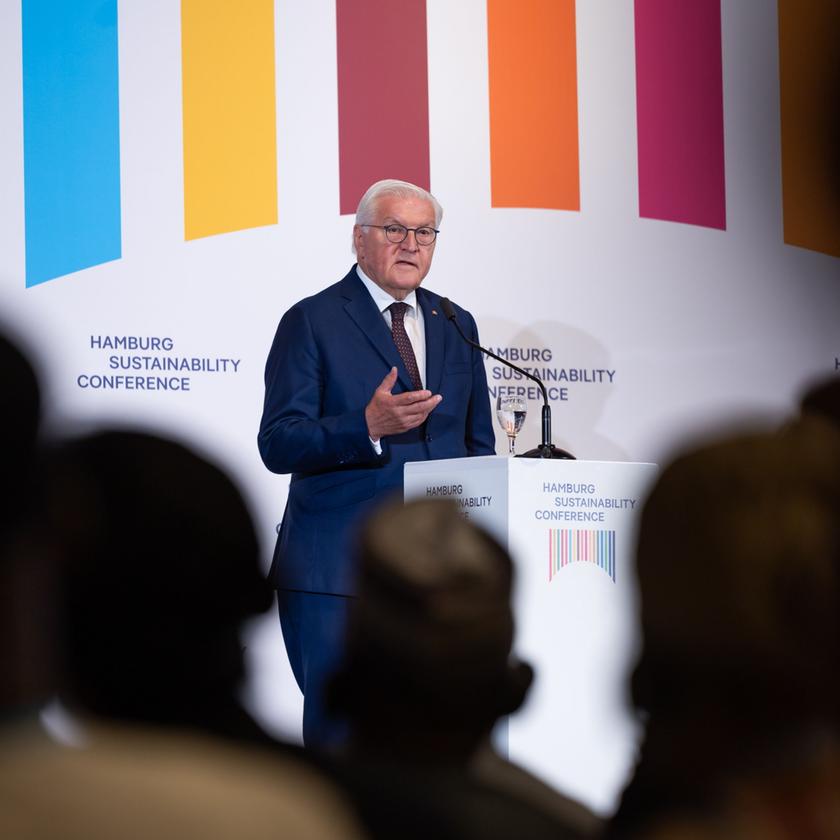
In a stirring address at the Hamburg Sustainability Conference, German President Frank-Walter Steinmeier issued a clarion call for Germany to bolster its commitment to the United Nations. Speaking to an audience of over 1,600 participants from 115 countries, Steinmeier emphasized the urgent need for international cooperation to tackle pressing global challenges such as climate change, poverty, and hunger. He warned against the growing trend of ‘raw power politics’ and ‘zero-sum thinking,’ which he described as eroding the foundations of the rule-based international order.
Steinmeier’s remarks come in the wake of Germany’s recent failure to secure a non-permanent seat on the UN Security Council—a setback he described as a ‘bitter defeat.’ While acknowledging the need for introspection, he criticized voices within Germany advocating for reduced engagement with the UN. ‘A retreat would be short-sighted and fatal,’ he declared, urging his country to reaffirm its commitment to multilateralism and global cooperation.
The President also called for reforms within the United Nations itself, emphasizing the need for greater efficiency and effectiveness. ‘The UN must prove that it can deliver better results than the strongmen with their fantasies of omnipotence,’ he stated, highlighting the importance of demonstrating the value of multilateral institutions in an era when their relevance is increasingly questioned.
The Hamburg Sustainability Conference, themed ‘The Power of Collaboration: Advancing Progress Together,’ provided a fitting backdrop for Steinmeier’s appeal. The event focused on resilient economies, technological innovation, and the future of human cooperation, aligning closely with the UN’s Agenda 2030 for sustainable development. This agenda, adopted 11 years ago, outlines 17 global goals, including eradicating poverty and hunger, ensuring access to clean water and energy, promoting quality education, and combating climate change.
Steinmeier’s speech underscored Germany’s pivotal role in addressing these challenges, both as a leading European power and as a committed member of the international community. His call to action serves as a reminder that the path to a sustainable and equitable future lies in strengthening global partnerships and upholding the principles of cooperation and mutual trust. As the winds of political brutality and recklessness threaten to undermine progress, Germany’s leadership in the UN could be a beacon of hope for a more collaborative world.
Steinmeier’s remarks come in the wake of Germany’s recent failure to secure a non-permanent seat on the UN Security Council—a setback he described as a ‘bitter defeat.’ While acknowledging the need for introspection, he criticized voices within Germany advocating for reduced engagement with the UN. ‘A retreat would be short-sighted and fatal,’ he declared, urging his country to reaffirm its commitment to multilateralism and global cooperation.
The President also called for reforms within the United Nations itself, emphasizing the need for greater efficiency and effectiveness. ‘The UN must prove that it can deliver better results than the strongmen with their fantasies of omnipotence,’ he stated, highlighting the importance of demonstrating the value of multilateral institutions in an era when their relevance is increasingly questioned.
The Hamburg Sustainability Conference, themed ‘The Power of Collaboration: Advancing Progress Together,’ provided a fitting backdrop for Steinmeier’s appeal. The event focused on resilient economies, technological innovation, and the future of human cooperation, aligning closely with the UN’s Agenda 2030 for sustainable development. This agenda, adopted 11 years ago, outlines 17 global goals, including eradicating poverty and hunger, ensuring access to clean water and energy, promoting quality education, and combating climate change.
Steinmeier’s speech underscored Germany’s pivotal role in addressing these challenges, both as a leading European power and as a committed member of the international community. His call to action serves as a reminder that the path to a sustainable and equitable future lies in strengthening global partnerships and upholding the principles of cooperation and mutual trust. As the winds of political brutality and recklessness threaten to undermine progress, Germany’s leadership in the UN could be a beacon of hope for a more collaborative world.
Drafted & Edited by Investigative Desk | AboMatrix