


The Hijab is Not an Islamic Obligation: The Forbidden Story of the Veil

The Hijab is Not an Islamic Obligation: The Forbidden Story of the Veil
The Hijab is Not an Islamic Obligation: The Forbidden Story of the Veil
By: Abu Bakr Al-Romoh
The Illusion of the “Sixth Pillar”:
We must ask: How did the patriarchal jurisprudential authority of parallel religion transform the hijab from a class-based social legislation into a “sixth pillar” of Islam? How did it turn into a political slogan? And why, in their jurisprudence, is an unveiled woman no longer considered sinful but rather an existential threat?
For generations, the “hijab” has been presented as the solid foundation of faith and the absolute measure of chastity, to the extent that a woman uncovering her hair in the contemporary popular imagination is viewed as a sin nearly equivalent to major transgressions.
However, revisiting the depths of Islamic and pre-Islamic history, and deconstructing the texts away from the ideological hijacking of political Islam movements, reveals a shocking truth. The hijab did not originate as a religious legislation, but rather as a “class-specific attire” dictated by ancient customs. It was acknowledged by early Islam for a specific social rationale that ended with the abolition of slavery, long before modern politics recycled it into an “identity.”
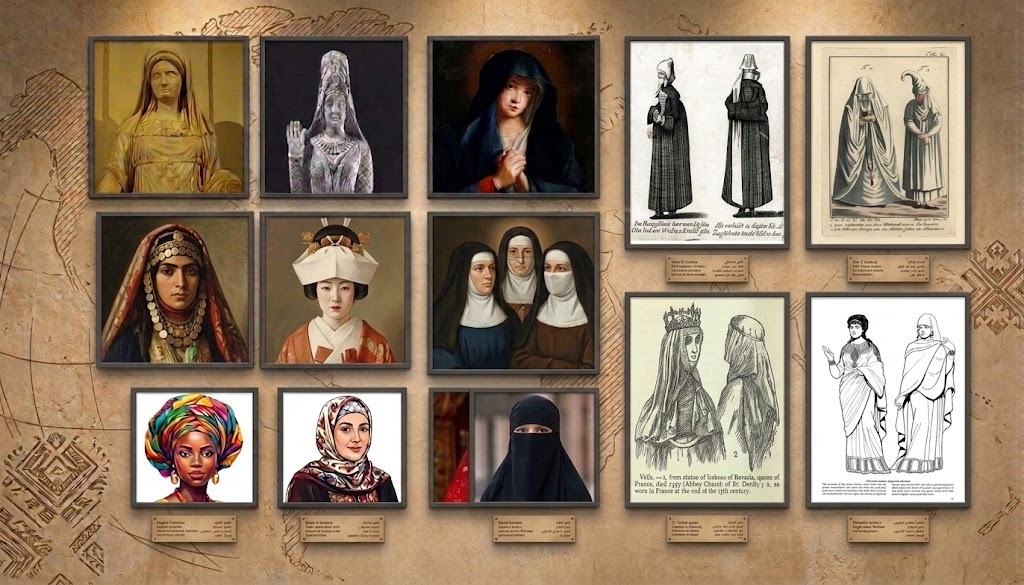
The hijab was never an exclusively Islamic garment. It was a deeply rooted practice in the legislations of ancient empires, functioning as a tool for social stratification. In Assyrian laws (circa 1200 BC), “Tablet A” explicitly mandated the punishment of slave women and prostitutes if they wore the veil. The hijab was strictly reserved for free, noble women to distinguish them from the lower classes.
In the Persian and Roman empires, a woman’s seclusion and head-covering were symbols of wealth. A woman working in the fields could not afford to hinder her movement with long cloaks and headscarves. Similarly, in Judeo-Christian traditions, Jewish customs mandated head coverings, and Saint Paul, in his epistles to the Corinthians, emphasized the necessity of a woman covering her head as a sign of submission.
Thus, pre-Islamic Arabs inherited this culture. The free woman covered her head as a sign of her sovereignty, while slave women were left bareheaded.
When Islam emerged, it interacted with the existing social reality and the institution of slavery. The most prominent verse regarding the hijab in Surah Al-Ahzab states: {O Prophet, tell your wives and your daughters and the women of the believers to bring down over themselves [part] of their outer garments. That is more suitable that they will be known and not be abused. And ever is Allah Forgiving and Merciful.} Al-Ahzab (59).
Exegetes like Al-Tabari and Al-Qurtubi mention that the streets of Medina were dark, and some corrupt youth would harass slave women. When a free woman went out at night to relieve herself, they might confuse her for a slave and harass her. The divine command came for free women to wear the Jilbab so they would be recognized as free and thus not be harmed.
To confirm that the hijab was meant for class distinction and not inherently to cover a shameful body part (Awrah), authentic sources such as Sunan Al-Bayhaqi and Musannaf Ibn Abi Shaybah record that Caliph Umar ibn Al-Khattab used to patrol the markets. If he saw a slave woman wearing a hijab, he would strike her with his whip and remove the veil, saying: “Why are slave women imitating free women?!”
If a woman’s hair were inherently a source of temptation (Fitnah), would it be conceivable for early Islam to order the heads and chests of hundreds of thousands of slave women in the markets to remain uncovered?
The truth is that the legislation aimed at social protection in a class-based society. This rationale has completely vanished today with the abolition of slavery. If the hijab was historically a jurisprudential and class-related issue open to debate, how has it today become the primary and sole criterion for judging a woman’s faith?
The answer lies in “politicization.” In the mid-20th century, the “Islamic Awakening” emerged. The popularity of political Islam movements—such as the Muslim Brotherhood, contemporary Salafism, and the 1979 Iranian Revolution—surged. These movements were in an open conflict with secular regimes, leftist currents, and Westernization. They desperately needed a uniform or a visual banner to declare their presence and expansion in the streets.
At this juncture, the hijab was no longer merely a jurisprudential ruling for modesty; it was ideologically engineered to become the undeclared “sixth pillar” of Islam. The entire Islamic identity was reduced to the woman’s body. The veiled woman became “Islam walking on two feet,” while the unveiled woman was framed as a Western infiltration and a threat to the Ummah (nation). The hijab transformed from a means of deflecting attention into a tool for declaring political, partisan, and tribal affiliation.
Today, you can observe societies that tolerate lying, illicitly consuming people’s wealth, and abandoning prayer (the actual second pillar of Islam), yet they cause an uproar if a woman takes off her hijab. This proves that the issue is no longer about religion and worship, but rather a tribal and political identity, where society punishes those who detach from it under the charge of “betraying the tribe.”
Faced with this polarization, scholars divided into two camps. The “Obligation Camp” consists of traditional institutional jurists and the parallel religion, who took the general wording of the texts out of the context of slavery. They relied on isolated (Ahad) Hadiths, such as the Hadith of Asma bint Abu Bakr—a Hadith with a weak and broken chain of transmission, as testified by Imam Abu Dawud himself, who narrated it. It is catastrophic to build an obligation equivalent to prayer on a weak Hadith.
Conversely, the “Maqasid (Objectives) and Historical Camp”—comprising scholars and thinkers like Gamal Al-Banna, Nasr Hamid Abu Zayd, and Muhammad Shahrour—relied on the golden jurisprudential rule: The ruling exists or disappears with its underlying cause (Illah).
Since the Quranic rationale for the hijab was to distinguish between the free woman and the slave, and today slavery is abolished and all women are legally free, there are no slaves to distinguish from. Since the rationale has completely disappeared, the ruling necessarily falls.
Based on the disappearance of the historical rationale and the modern political weaponization of the issue, linking a woman’s righteousness to a piece of cloth is a jurisprudential exaggeration and a hijacking of religion. Categorizing an unveiled woman as disobedient confiscates the essence of faith, which is built on justice, ethics, and purity of heart. In the modern era, uncovering hair is not a departure from norms or an invitation to temptation; it is the natural appearance of a woman.
Consequently, a woman who adheres to general modesty and noble morals without wearing a head cover is a woman exercising her freedom within the framework of modern human norms. She does not violate the definitive tenets of faith, and there is no religious justification to consider her sinful or deficient in faith.
One of the most horrific crimes committed by politicized religious discourse is the use of the term Tabarruj as an insult to stigmatize unveiled women with moral decay. Linguistically, Tabarruj comes from Burj (tower), meaning to show off and act artificially to attract attention, as if a woman is making herself a tower of ostentation.
In the Quran, this address was exclusively directed at the Prophet’s wives (“And do not display yourselves as was the display of the former times of ignorance”). The intent was to forbid them from the ostentatious behaviors and displays of wealth and arrogance prevalent among upper-class women in the pre-Islamic era. It is an exhibitionist behavior, not merely uncovering hair. Tabarruj was never mentioned in the Quran to mean a woman going out to work and participating in life with uncovered hair. Taking this term and hurling it at a modern, hardworking, and righteous woman simply because she does not cover her head is linguistic forgery and a distortion of the text to psychologically terrorize women and subjugate them to society’s authority.
Conclusion:
Religion came to liberate humanity, not to imprison it in formalistic molds. Transforming the hijab from a social practice tied to the era of slavery into a political identity and a “sixth pillar” by which women’s honor is measured is the product of patriarchal and political jurisprudence, not a sacred divine will. Chastity resides in the mind and the heart. God looks at hearts and deeds, not at ideological banners hung on women’s heads.